
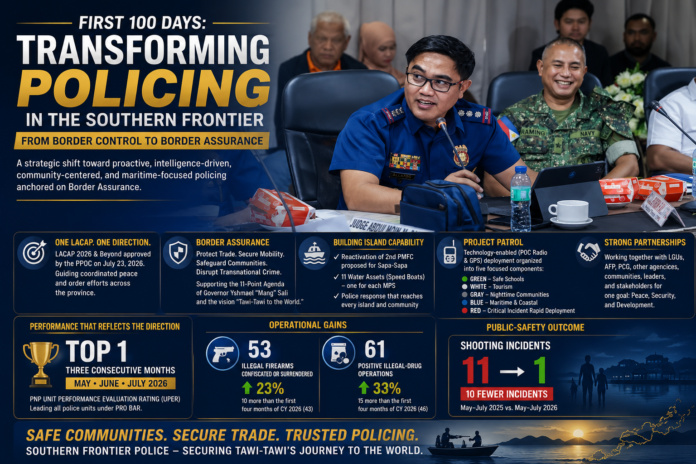

The first 100 days of PCOL BYRON FILOG ALLATOG as Police Provincial Director of the Tawi-Tawi Police Provincial Office (TTPPO) marked a deliberate shift in policing, from largely traditional and reactive law enforcement toward a proactive, intelligence-driven, community-centered, and maritime-focused approach anchored on Border Assurance
The shift responds to the realities of Tawi-Tawi. As the country’s southernmost frontier and an emerging gateway of BARMM to the Brunei Darussalam–Indonesia–Malaysia–Philippines East ASEAN Growth Area (BIMP-EAGA), the province holds strategic importance for trade, tourism, fisheries, investment, and maritime connectivity.
But opportunity comes with security challenges. Tawi-Tawi’s dispersed islands, extensive maritime areas, cross-border movement, and coastal communities require policing that goes beyond conventional land-based law enforcement.
The response was to establish one strategic direction for policing the Southern Frontier.
ONE LACAP. ONE DIRECTION
At the center of this direction is the Local Anti-Criminality Action Plan (LACAP) 2026 & Beyond, entitled:
“Securing the Southern Gateway 2026 & Beyond: An Intelligence-Driven, Community-Centered Policing Strategy for Trade, Tourism, Environmental Protection, and Human Security in Tawi-Tawi.”
A major milestone during the first 100 days was the approval of the Tawi-Tawi Police’s “LACAP 2026 & Beyond” by the Provincial Peace and Order Council (PPOC) during its 2nd Quarter Meeting on July 23, 2026.
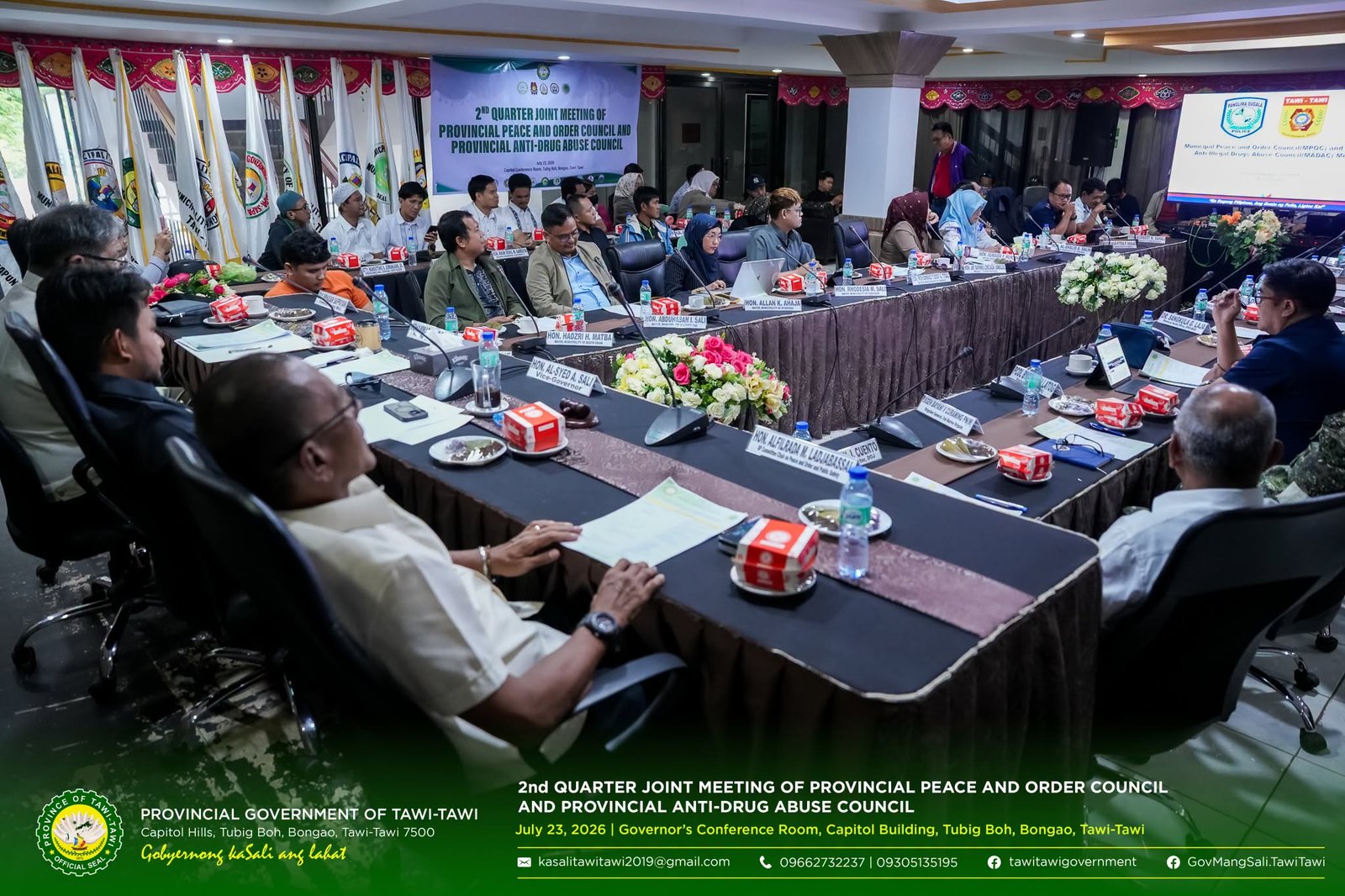
The LACAP unifies police efforts through three approaches: Intelligence-Driven Policing, Community and Service-Oriented Policing, and Inter-Agency and Multi-Sectoral Collaboration. Together, these align operations, deployment, technology, partnerships, and resources toward one objective: a safer and more secure Tawi-Tawi that enables lawful economic and social activity.
FROM BORDER CONTROL TO BORDER ASSURANCE
The LACAP advances a “Border Assurance Strategy.”
Border Assurance does not diminish the traditional law-enforcement mandate. It strengthens it while recognizing a broader security responsibility: protect legitimate trade, facilitate secure mobility, safeguard maritime communities, protect tourism and natural resources, and disrupt transnational criminal networks.
Simply put, police do not build the economy, but police help create the secure environment in which an economy can grow.
This aligns policing with the 11-Point Agenda of Governor Yshmael “Mang” Sali and the broader vision of bringing “Tawi-Tawi to the World.”
BUILDING CAPABILITY FOR AN ISLAND PROVINCE
Strategy must be supported by capability.
Among the initiatives pursued is the reactivation of the 2nd Provincial Mobile Force Company (PMFC), strategically proposed for Sapa-Sapa, to strengthen maneuver capability, rapid deployment, and humanitarian assistance and disaster response. The PPOC endorsed the proposal and approved a resolution seeking its reactivation to the PNP NHQ and NAPOLCOM.
The strategy likewise advances efforts to provide water mobility capability (speed boats) to all eleven (11) Municipal Police Stations (MPS). In an island province, police response cannot end where the road ends. Police must be capable of reaching coastal and maritime communities, responding to emergencies, protecting marine resources, and conducting law-enforcement operations at sea. Recognizing this operational necessity, the PPOC endorsed the proposal and approved a resolution supporting investment in 11 water assets—one for each MPS.
Simply put: police capability must correspond to the geography it is expected to protect.
https://youtu.be/Tpy20DJmT34?si=NqxR-sH6NNEWwsoT
PROJECT PATROL: TRANSLATING STRATEGY INTO ACTION
If the LACAP provides the blueprint and Border Assurance sets the strategic approach, PROJECT PATROL translates that direction into visible police action.
Patrol-the backbone of policing-was strengthened through GPS-enabled Push-toTalk over Cellular (PoC) radios. During the first 100 days, traditional police visibility was enhanced through PROJECT PATROL—a technology-enabled system using PoC, allowing deployment more systematic, measurable, responsive, and accountable.
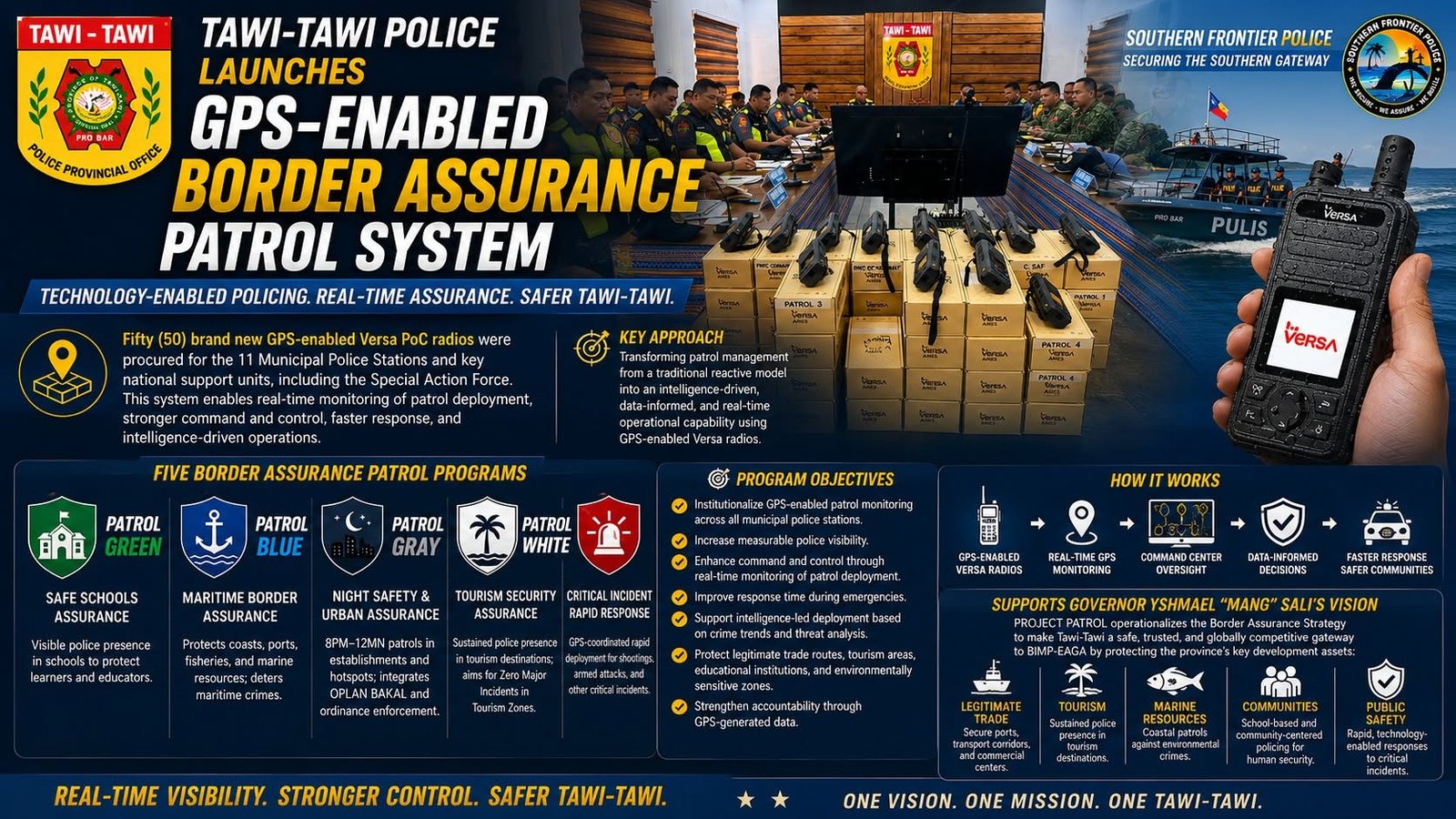
PROJECT PATROL organizes police presence into five focused components:
PROJECT PATROL GREEN – Safe Schools Assurance.
PROJECT PATROL WHITE – Tourism Assurance.
PROJECT PATROL GRAY – Nighttime Safer Communities.
PROJECT PATROL BLUE – Maritime and Coastal Assurance.
PROJECT PATROL RED – Critical Incident Rapid Deployment.
Together, these connect technology, deployment, command-and-control, police visibility, community needs, and police accountability. It translates Border Assurance into action by putting the right police presence, at the right place, for the right purpose.
FROM DIRECTION TO MEASURABLE PERFORMANCE
The first indication that this unified direction was translating into organizational performance came through the PNP Unit Performance Evaluation Rating (UPER).
From May to July 2026 (first 100 Days), Tawi-Tawi PPO ranked Top 1 for three consecutive months in the PNP Unit Performance Evaluation Rating (UPER), leading police units under Police Regional Office–Bangsamoro Autonomous Region covering Cotabato City, Lanao del Sur, Maguindanao del Sur, Maguindanao del Norte, and Basilan.
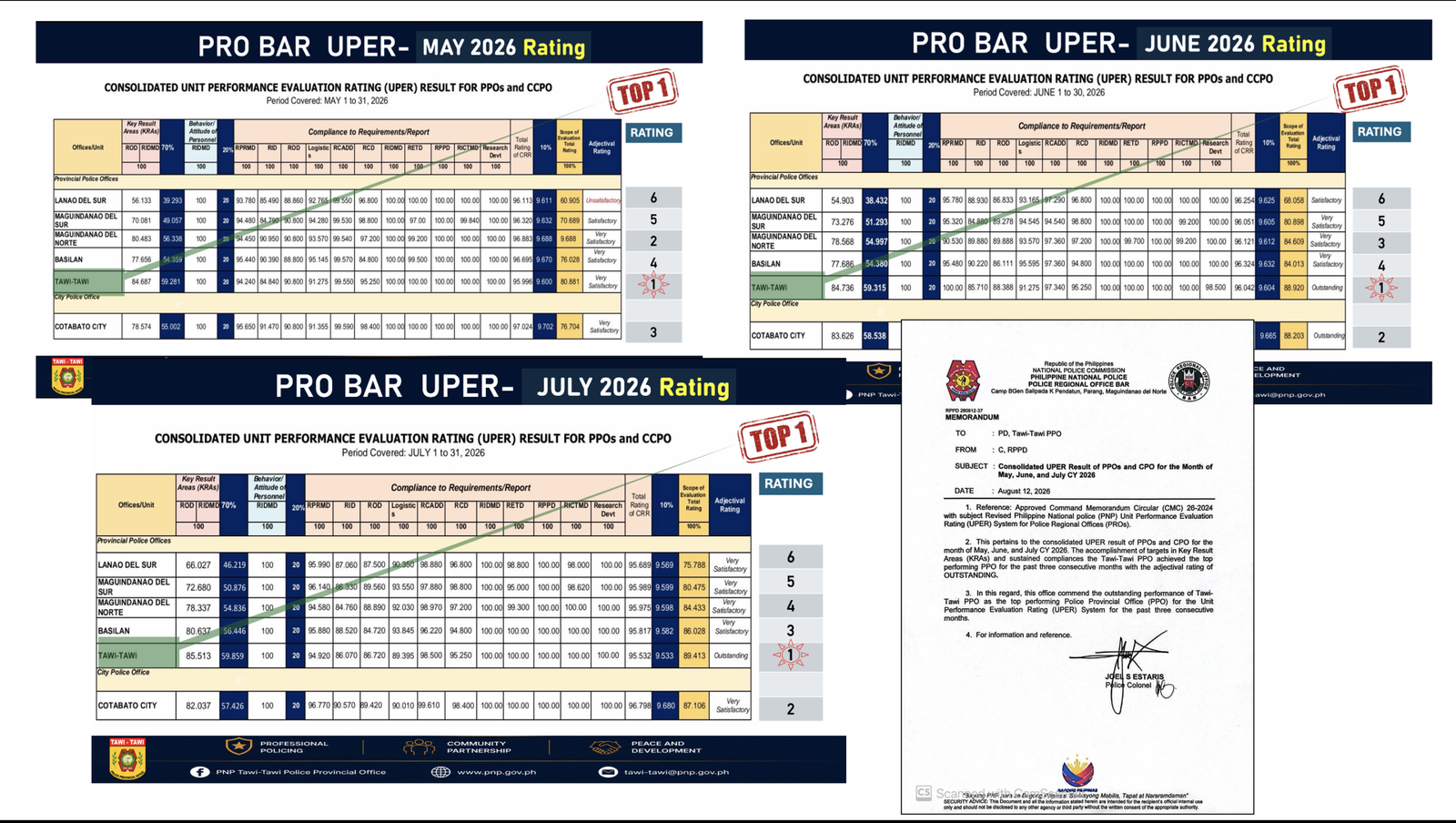
Beyond ranking, UPER measures key dimensions of police performance, including law enforcement, crime prevention and solution, personnel and administration, discipline, and community engagement.
Three consecutive Top 1 rankings, therefore, provide an institutional indicator that the unit’s strategic direction is translating into measurable performance.
FROM POLICE OUTPUTS TO PUBLIC-SAFETY OUTCOMES
Operational performance also improved during the first 100 days.
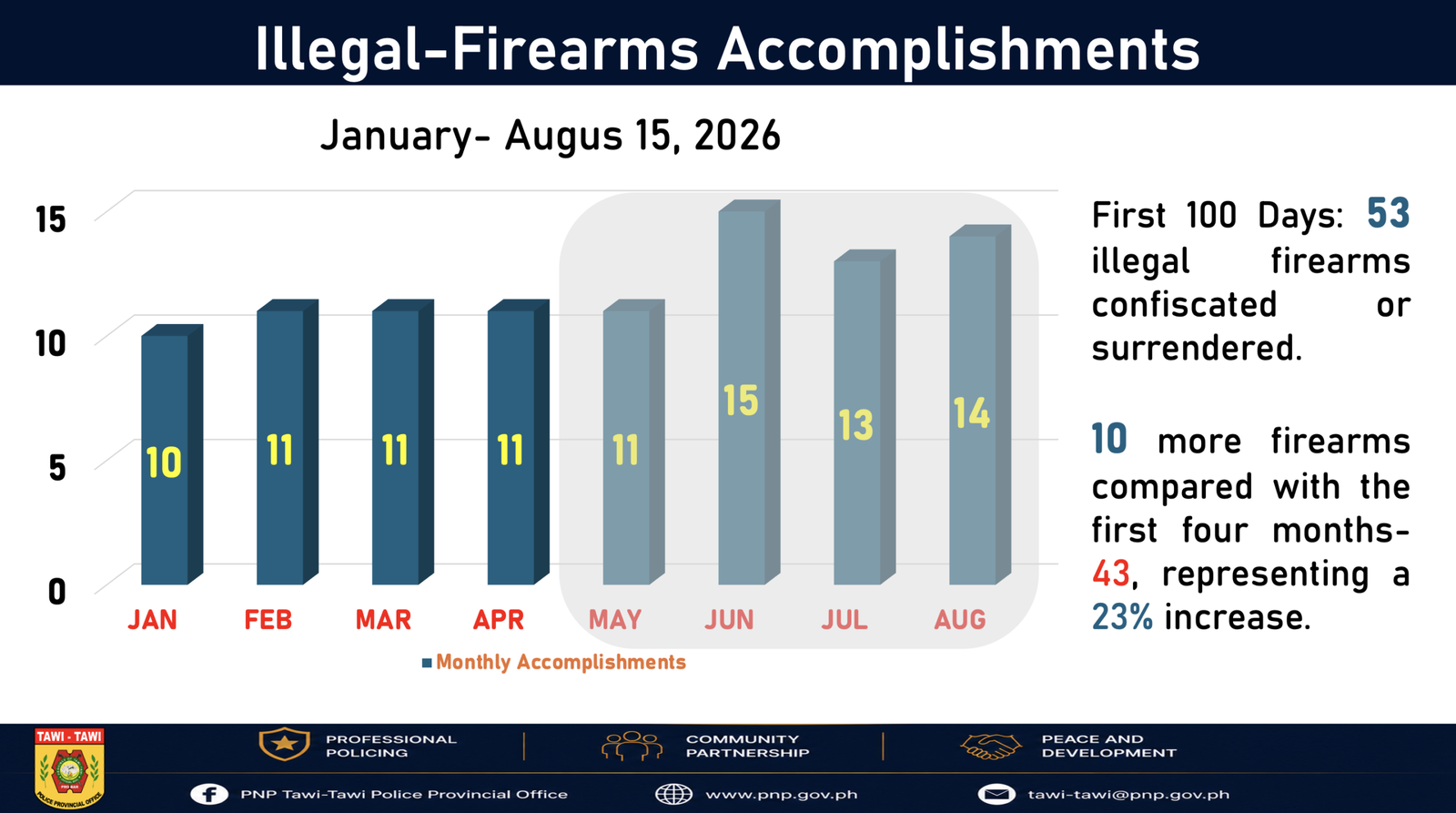
53 ILLEGAL FIREARMS CONFISCATED OR SURRENDERED
A total of 53 illegal firearms were confiscated or surrendered—10 more than the 43 recorded during the first four months of CY2026, representing an approximately 23% increase.
Removing illegal firearms from communities reduces weapons potentially available for shootings, armed violence, and other crimes.
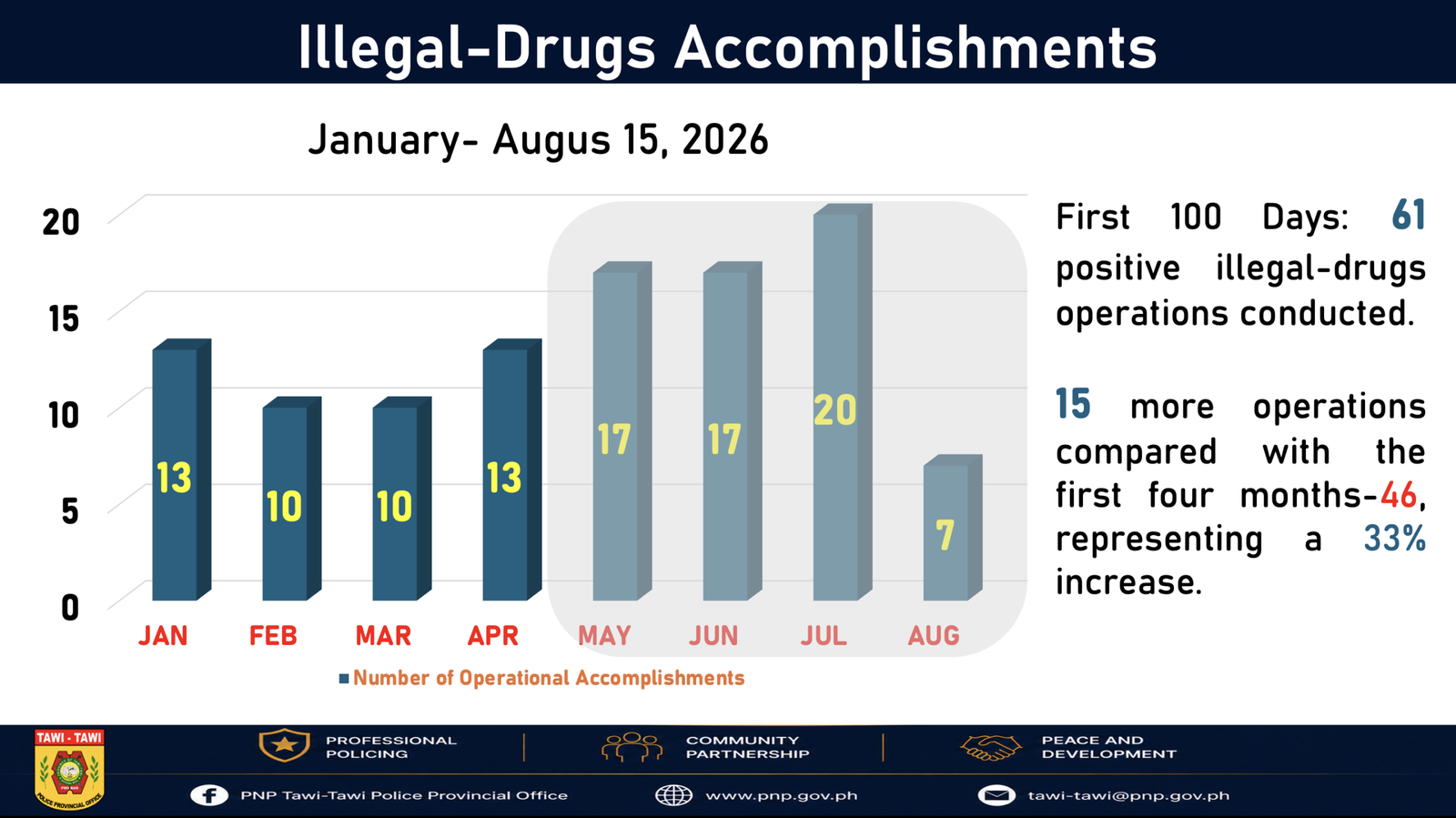
61 POSITIVE ILLEGAL-DRUG OPERATION
TTPPO conducted 61 positive illegal-drug operations—15 more than the 46 operations during the first four months of CY2026, representing an approximately 33% increase.
These figures reflect intensified intelligence gathering, coordination, and enforcement against illegal drugs.
But, police operations should not be measured by operations alone.
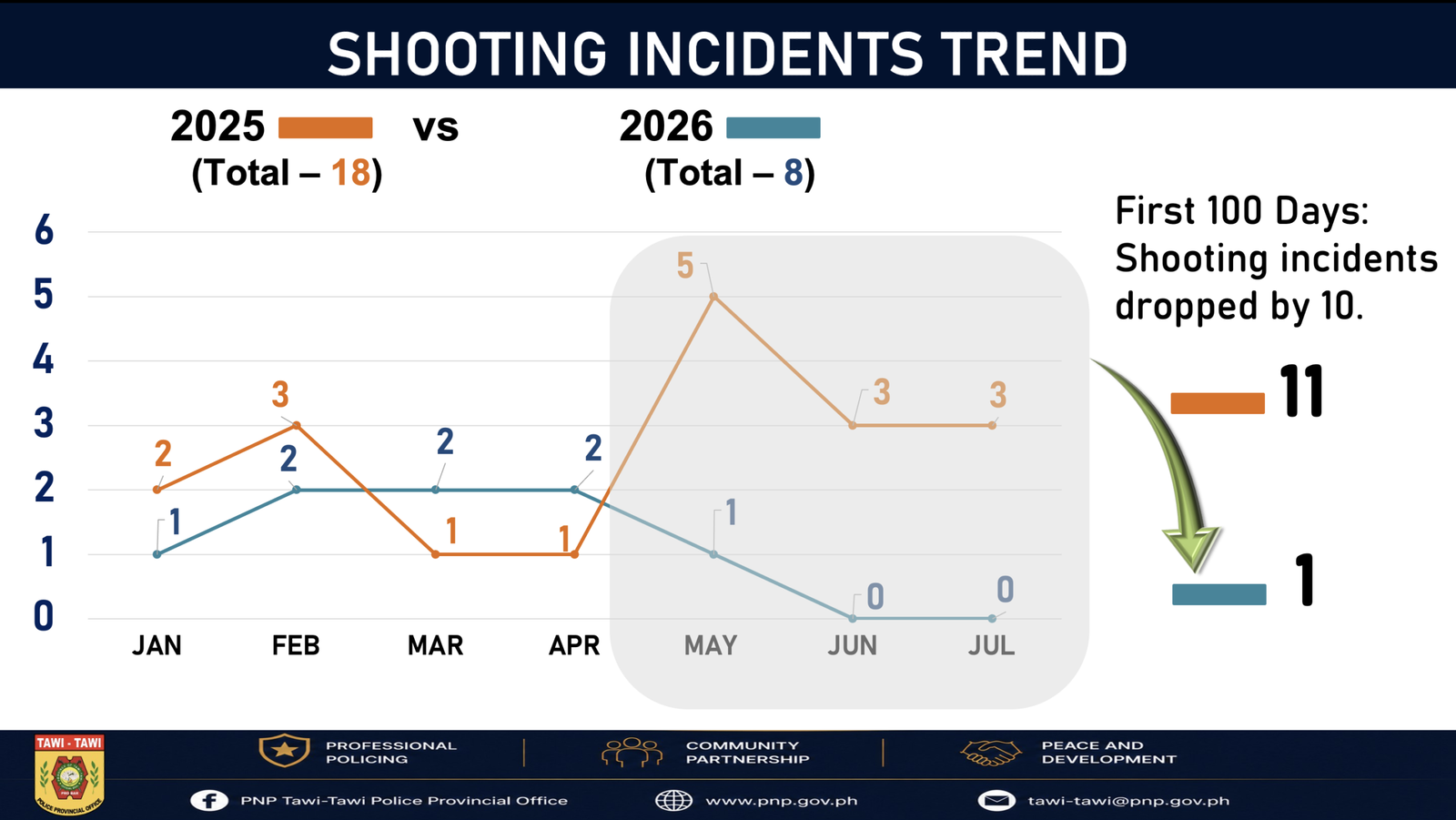
10 FEWER SHOOTING INCIDENT
The more significant indicator is what happened in the community.
Comparing May–July 2025 with May–July 2026, shooting incidents dropped from 11 cases to only 1, a reduction of 10 incidents.
The firearms confiscated, drug operations conducted, and other police activities represent outputs. The reduction in violence begins to demonstrate outcome.
Because ultimately, the measure of policing is not simply how many operations are conducted or arrests are made, but whether crime is prevented, violence is reduced, communities are protected, and people feel safer.
PROJECTING STRENGTH, BUILDING PARTNERSHIPS
These gains cannot be attributed to police action alone.
“Border Assurance” combines strong law enforcement with strong partnerships.
Peace, order, and security in Tawi-Tawi require the collective effort of the Provincial Government, Municipal LGUs, AFP, PCG, other law-enforcement agencies, BARMM ministries, national government agencies, communities, religious and traditional leaders, civil society, and the private sector.
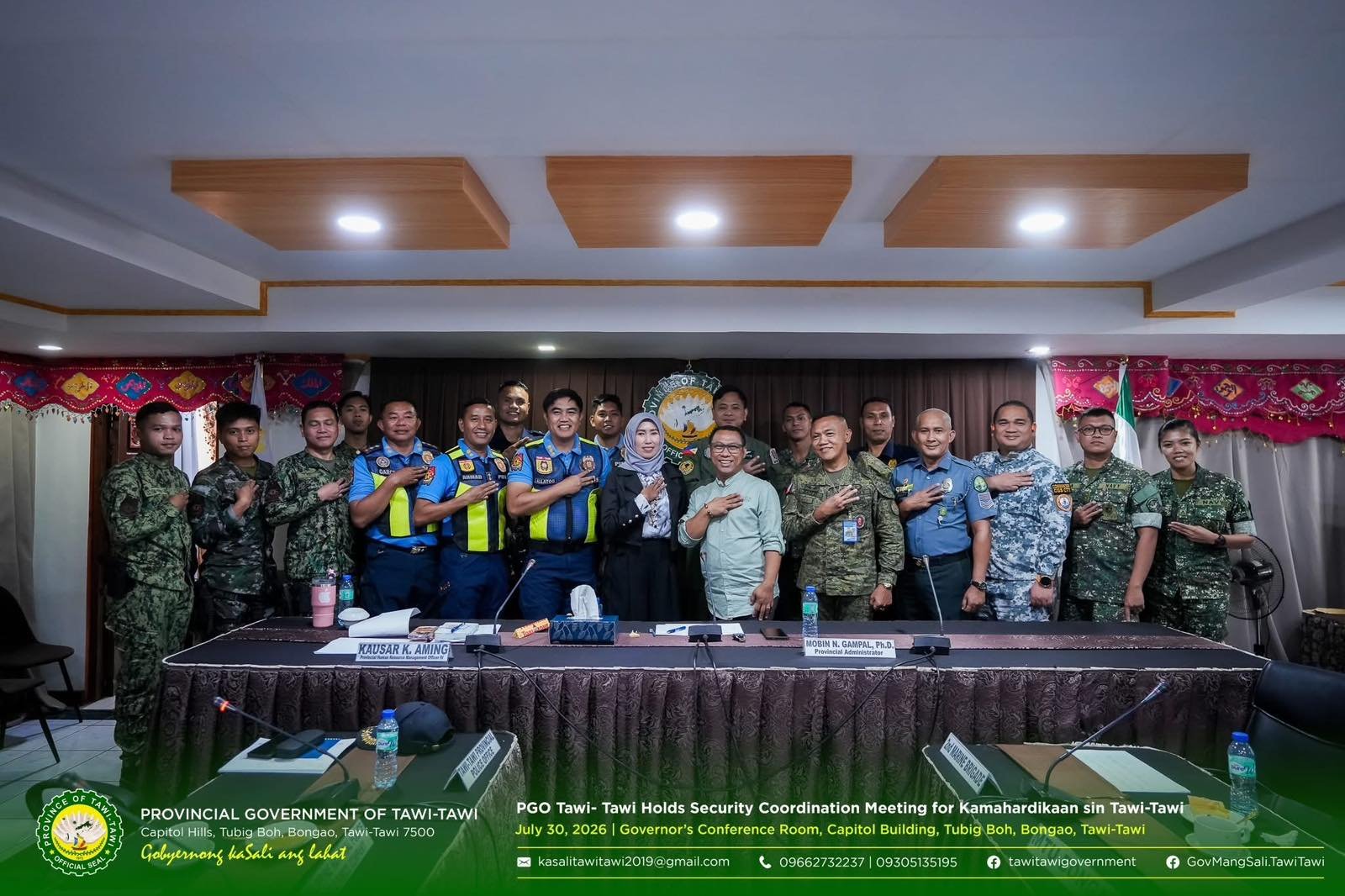
This is why inter-agency and multi-sectoral collaboration is embedded in the LACAP.
The objective is not simply to conduct more activities. It is to bring different institutions behind one security direction.
When government, law enforcement, security forces, communities, and stakeholders work toward a common objective, individual operations become part of a larger system for peace, security, and development.
POLICING THAT ENABLES DEVELOPMENT
Border Assurance ultimately connects security with opportunity.
Police do not build the economy- but police help create the conditions in which an economy can grow.
Secure ports support commerce. Safe waters protect fisheries and maritime activity. Protected tourism destinations encourage visitors. Safe communities strengthen investor confidence. Effective law enforcement protects legitimate businesses. Public confidence allows people and goods to move securely.
This defines the evolving role of the Southern Frontier Police-not merely guarding the country’s southern frontier, but helping make Tawi-Tawi a safe, secure, trusted, and reliable gateway to BIMP-EAGA.
FIRST 100 DAYS: BUILDING THE FOUNDATION
The first 100-days were not defined by a single project, operation, or statistic. They were about establishing direction and building the foundation.
The LACAP provided the policing blueprint.
Border Assurance provided the strategic approach.
Project PATROL translated the blueprint into operational translation.
Technology strengthened command & control, and accountability.
Operational Gains demonstrated enforcement capability.
Partnerships brought stakeholders toward a common direction.
And Reduced Shooting Incidents provided an early measure of impact.
The task ahead is to institutionalize these gains—strengthening maritime and maneuver capabilities, sustaining operational performance, deepening partnerships, and ensuring that every police initiative contributes to the larger vision for the province.
The first 100 days established the foundation.
Safe Communities. Secure Trade. Trusted Policing. Southern Frontier Police-Securing Tawi-Tawi’s Journey to the World.
by: PCAPT John Mark J. Maandal
__________________________