

Globally, in policing, courage is often measured in split seconds—when an officer runs toward danger while others run away. Physical bravery is visible. It earns medals, headlines, and salutes. However, for police leaders, the more enduring test is rarely found in the streets. Rather, it is found in decisions made behind closed doors, in uncomfortable conversations, and in moments when silence would be easier than truth.
Indeed, true courage is not only about-facing danger; it is about choosing to act rightly even when it costs comfort, command, popularity, and or advantage.
In this context, Moral Courage goes beyond the instinct to protect. It is the deliberate choice to speak the truth—even when it is unpopular—and to uphold integrity despite pressure from peers, subordinates, or superiors. It requires the strength to speak one’s mind when principles are at stake. It demands enforcing the law fairly—even against powerful interests, influential personalities, or familiar religious groups. Thus, in such moments, the badge is tested not by danger, but by temptation—by the pull of convenience, conformity, and the urge to align with prevailing trends rather than stand firmly on principle.
For this reason, moral courage is not optional for police leaders; it is foundational. Authority without integrity erodes trust. Command without character breeds fear, not respect. A leader may command compliance through rank, but only moral courage commands legitimacy.
At its core, the deeper truth is this: courage itself requires courage.
More often than not, the most difficult battles are internal—the battle against ego, when pride tempts us to defend a wrong decision instead of correcting it; the battle against compromise, when expediency whispers that “pwede na ito” will suffice; and the battle against silence, when remaining quiet feels safer than confronting misconduct, injustice, or inefficiency.
Meanwhile, in a police organization still navigating the transition from military doctrine to a community-based doctrine, leadership courage becomes decisive. Laws and reforms alone cannot transform culture and policies cannot replace personal conviction. Therefore, while institutional reforms and global policy standards are necessary to build a strong police force, there is an equal need for police leaders to demonstrate, act upon, and instill in every command the courage to be courageous.
Ultimately, leadership demands victory in these unseen battles.
To be courageous in policing is to hold yourself to the same standards you enforce. It means disciplining a subordinate who is a friend. It means saying “no” to a religious entity that supported your rise to command. It means declining favors that blur professional lines. It means resisting political pressure that undermines fairness. It means admitting mistakes and correcting them transparently. Although, these acts may not make headlines, but they build institutional credibility—brick by brick.
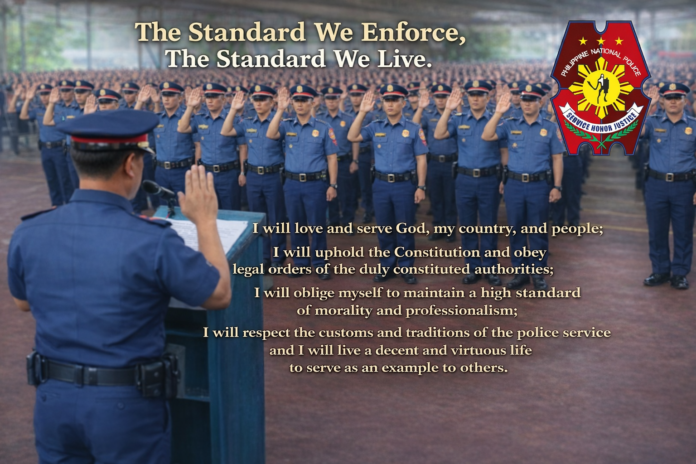
Similarly, engaging in certain high-cost leisure activities—such as golf, where equipment, club memberships, and related expenses can be substantial—may unintentionally contradict the principle of modest living that we consistently advocate. This tension becomes more pronounced when we publicly recite the PNP Officers’ Pledge, obliging ourselves to “maintain a high standard of morality and professionalism and to live a decent and virtuous life to serve as an example to others.” When personal choices appear inconsistent with these words, a gap emerges between declaration and demonstration. The issue is not the activity itself, but the alignment between what we pledge in ceremony and what we practice in daily life. In other words, LEADERSHIP demands COHERENCE: the standard we enforce must be the standard we live.
Certainly, physical bravery is expected in our profession. We train for it. We prepare for it. Society anticipates it from those who wear the uniform. Yet, moral bravery is where leaders are truly measured. It is tested in policy decisions, resource allocation, personnel actions, and operational priorities. It is revealed when we choose principle over convenience.
Therefore, the courage to be courageous is the decision to live up to your own standards—especially when no one is watching. It is choosing integrity over influence, accountability over applause, and service over self-interest.
For police leadership, this is the higher calling. Our men and women will mirror what we tolerate, what we reward, and what we exemplify. If we demonstrate moral courage, we cultivate a culture of ethical policing. Conversely, if we compromise—even slightly—we signal that compromise is acceptable.
In the end, the badge is not strengthened by displays of force alone. It is strengthened by quiet, consistent acts of moral courage. While physical bravery protects lives in moments, moral bravery protects the police institution for generations.
Thus, the question for every Lakan leader is not simply, “Are you brave?”
It is, “Lakan, do you have the courage to be courageous?”
by: Byron Filog Allatog
—————————————————
DISCLAIMER
The views, analyses, and conclusions expressed in this article are solely those of the author and are presented in a personal academic capacity. They do not necessarily reflect the official policies, positions, or views of the Philippine National Police (PNP), the Armed Forces of the Philippines (AFP), the Government of the Republic of the Philippines, or any other institution with which the author may be affiliated.
CSOP101 serves as an independent professional learning platform dedicated to advancing scholarship and practitioner discourse on Community and Service-Oriented Policing (CSOP), public safety, governance, and nation-building. Contributions published on this site—including policy commentaries, practitioner reflections, and academic essays—are intended to encourage informed discussion and knowledge sharing within the policing and public policy community.
Responsibility for the content of each article rests solely with the author. Any errors, interpretations, or opinions expressed are the author’s own. For inquiries, clarifications, or scholarly correspondence related to this article, readers may contact the author at byron.allatog012@gmail.com.